
By Guo Ding; translated and edited by Yan Liu
According to the International Energy Agency (IEA), China has become the largest energy consumer on earth. Although China’s individual energy consumption falls far behind that of the U.S., the question remains how well the world’s most populated state is able to integrate sustainability into its development agenda.
Different Reactions to the Same Development
As China’s total energy consumption increases, a number of previously neglected issues including water pollution and excessive deforestation have begun to capture as much international attention as human rights and religious freedom. Diplomatically, China’s growing dependence on African oil has driven elites in Africa and the West to view China as a neo-colonizer, collaborator of oppressive regimes, and barrier to liberal reforms. Moreover, China has stimulated the West and neighboring states by modernizing its naval power—an ongoing attempt to safeguard its access to imported resources.
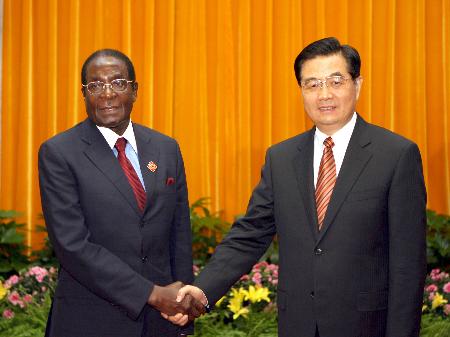 |
| Chinese President Hu Jintao with Mugabe in 2006 (Image source: Sina News) |
Ironically, Beijing has a positive impression of its growing energy demand. To many Chinese analysts, China’s development has benefited major energy exporters in Australia, Africa, and the Middle East by pushing up resource prices in the global market. Perceiving itself as a contributor to international development, Beijing has consequently failed to understand how various countries in the world could still view its development negatively, especially in the case of the U.S. and Europe.
China’s Opportunities
In the face of external doubts and criticisms, China is not in a position to suspend its development. In contrast, to reinforce its claim to economic growth, Beijing has gradually learned to emphasize sustainability in its development agenda—a measure to save itself from a disaster domestically and to justify its growth internationally.
On the one hand, China’s understanding of sustainability has found expression in its joint development plans in Africa. Today, Chinese investors are putting more resources into local education and health services, both of which are necessary for creating a sustainable development model in the host countries.
On the other hand, China has taken the lead to accelerate the development of green energy. As the world opinion on climate change becomes increasingly unified, China is unwilling to be the largest energy consumer. A greener economy will certainly provide Beijing with more confidence and legitimacy in the international community.
 |
| China's Hybrid Cars (Picture Source: Infzm.com) |
Guo Ding is contributing writer with China's Southern Weekly. His article was originally published on August 10th, 2010. Yan Liu is Program Coordinator at Bridging Nations College of Energy and Environment, where he is responsible for the Mentorship Program.


No comments:
Post a Comment