Economic and policy incentives for renewable energy: comparing the state of wind energy in the United States and Europe

Wind power is the fastest growing sector among renewable energy alternatives. The World Energy Report in 2009 found that world wind energy production has quadrupled between 2000 and 2006. This figure is projected to rise consistently and predicted to double every two years. Currently, the United States harnesses the largest share of installed wind power capacity at 35,159 Mega Watts (MW). Germany’s installed wind power capacity is the second largest at 25,777 MW. Although the United States has the lion’s share of installed wind power capacity, it only constitutes for less than 2% of electricity production in the United States. On the other hand, Germany’s electricity production from renewable energy has risen from 6.3 to 16.1% in 2009. The total installed wind power capacity within the European Union accounts for 74,767 MW.
Source: DOE


The growth of wind energy deployment in Germany correlates with the planning and implementation of the European Emissions Trading Program (EU ETS) in compliance with the targets set by the Kyoto Protocol. Although, EU ETS concentrates much of its regulations on cap and trade for carbon dioxide, the byproduct of these measures has allowed for innovation and exploration of renewable energy to offset green house gas emissions. As such, members of the European Union through EU ETS have lead the way in implementing Renewable Portfolio Standards (RPS) in order to regulate and increase energy production through renewable sources. The EU ETS is the first multinational program that has allowed the introduction of wind power through economic policies favoring an increase in its use. The legislative backings given by EU ETS have created green job markets within various European countries. Notably, Netherlands has harnessed wind power and produces the most energy per capita from wind energy. For Netherlands, the use of economic and political incentives has created a rising sector for jobs and an industry for wind energy.

In the United States, a federal program comparable to EU ETS has yet to be implemented. However, state level policy initiatives have been introduced to encourage the growth of renewable technologies. A total of 30 states have implemented their own RPS programs allowing an expansion in demands for wind power. States such as Texas are leading the way in wind energy production. Similar to EU ETS programs, state initiatives to introduce RPS programs stem largely from programs that help to mitigate climate change and find renewable sources for energy security. Europe’s growth in renewable energy can be attributed to comprehensive top-down energy policies. Conversely, the growth of renewable energy in the United States stems largely from economic demands and a “bottom-up” introduction of legislation towards alternative energy. In 2008, the Obama administration made energy policies a priority. Since the change in administration, the American Clean Energy Security Act (ACES) bill, introduced in 2009, has been approved by the House. However, a similar measure to introduce a Clean Energy bill in Senate has been stalled amidst opposition.

In implementing top-down initiatives, Europe has proven that by mandating both national and multinational incentives for renewable energy, market demands for wind power could rise drastically. Similarly, the United States could model the example of the EU ETS and provide similar means of promoting alternative sources of energy such as introducing a comprehensive federal clean energy policy similar to that of the EU ETS or a cap and trade program which is currently being discussed as the potential strategy to encourage market growth in the renewable energy sector. The EPA estimates that with the use of the cap and trade program each ton of CO2 would cost around $11 to $15 in 2012 and increase to $28 by 2025. As such the cap and trade program is projected to generate about $50 billion to $70 billion in 2012 and $90 billion to $120 billion in 2025. These estimates show that carbon trading could create a market with the potential to stimulate growth of renewable energy-particularly wind energy- within the United States. If a federal program was mandated along with the existing state level PRS programs, wind power could potentially grow from an already impressive and expanding renewable energy market.

All stats and data were retrieved from the World Wind Energy Report (2009), 9th World Wind Energy Conference & Exhibition Large-scale Integration of Wind Power,  EPA estimates on market values of Carbon Trading, and the Renewable 2010 Global Status Report.

Reflections on China’s Traffic Jam

by Devin James Benavidez

Recently, there has been a lot of publicity surrounding the ongoing traffic jam outside of Beijing. The 60 mile-long traffic jam involves an estimated 10,000 vehicles and stretches from the capital city to Inner Mongolia. The congestion originally developed as a result of a freeway maintenance project and a spike in the number of trucks carrying coal from the reserves in Inner Mongolia to power plants in Beijing. As I write, the traffic jam has been going on for eleven days, and some officials estimate that it will not completely clear up until after the road maintenance is finished in mid-September. Many have argued that this traffic snafu symbolizes the pitfalls underlying China’s overheated economic development. However, the growing number of cars on the road gives Chinese auto manufacturers a chance to become strategic players in the future of the global auto industry.

(Photo Courtesy of Newsopi.com)


China’s automotive industry is an excellent indicator of the speed at which the Chinese economy is developing, even in the midst of the global recession. China already has the biggest and fastest growing auto market in the world. For example, last year 13.6 million cars were sold in China, compared to only 10.4 million in the U.S. The growth of the Chinese automotive industry has led it to the brink of becoming a major automotive exporter to other regions of the globe. This will have huge implications in that Chinese auto manufacturers will soon have the power to influence what people will be driving in many parts of the world. In the fight for the development of clean energy technologies, the Chinese auto industry can play a very strategic role.

The Chinese government has already committed to becoming a leader in green energy technologies. To provide tangible evidence that they are attempting to follow through on said commitment, the Chinese government just released a plan which would invest billions of dollars in the development of technologies for hybrid and electric vehicles. At this point, only minimal information about the plan was released by officials, but there have been some reports from state-run media in China that the government intends to invest $15 billion in this program. If true, this would certainly be one of the most ambitious investments in the development of hybrid and electric vehicle technologies to date.

Announced by the state-owned Assets Supervision and Administration Commission, this plan hopes to produce over a million hybrid and electric vehicles over the next few years. Officials from Beijing said that they expect 500,000 energy efficient cars to enter the market each year over the next three years. This falls in line with China’s overarching promise to combat pollution and to reduce its carbon footprint, while simultaneously creating jobs in the emerging renewable energy technologies sector.

Devin Benavidez is a Research Intern at Bridging Nations in Washington, D.C., and has a BA in political science from California State University, Long Beach.

China’s Challenge and Opportunity

By Guo Ding; translated and edited by Yan Liu

According to the International Energy Agency (IEA), China has become the largest energy consumer on earth. Although China’s individual energy consumption falls far behind that of the U.S., the question remains how well the world’s most populated state is able to integrate sustainability into its development agenda.

Different Reactions to the Same Development

As China’s total energy consumption increases, a number of previously neglected issues including water pollution and excessive deforestation have begun to capture as much international attention as human rights and religious freedom. Diplomatically, China’s growing dependence on African oil has driven elites in Africa and the West to view China as a neo-colonizer, collaborator of oppressive regimes, and barrier to liberal reforms. Moreover, China has stimulated the West and neighboring states by modernizing its naval power—an ongoing attempt to safeguard its access to imported resources.


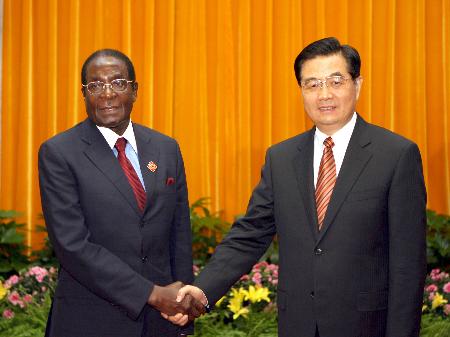
Chinese President Hu Jintao with Mugabe in 2006 (Image source: Sina News)

Ironically, Beijing has a positive impression of its growing energy demand. To many Chinese analysts, China’s development has benefited major energy exporters in Australia, Africa, and the Middle East by pushing up resource prices in the global market. Perceiving itself as a contributor to international development, Beijing has consequently failed to understand how various countries in the world could still view its development negatively, especially in the case of the U.S. and Europe.

China’s Opportunities

In the face of external doubts and criticisms, China is not in a position to suspend its development. In contrast, to reinforce its claim to economic growth, Beijing has gradually learned to emphasize sustainability in its development agenda—a measure to save itself from a disaster domestically and to justify its growth internationally.

On the one hand, China’s understanding of sustainability has found expression in its joint development plans in Africa. Today, Chinese investors are putting more resources into local education and health services, both of which are necessary for creating a sustainable development model in the host countries.

On the other hand, China has taken the lead to accelerate the development of green energy. As the world opinion on climate change becomes increasingly unified, China is unwilling to be the largest energy consumer. A greener economy will certainly provide Beijing with more confidence and legitimacy in the international community. 
China's Hybrid Cars (Picture Source: Infzm.com)

Guo Ding is contributing writer with China's Southern Weekly. His article was originally published on August 10th, 2010.  Yan Liu is Program Coordinator at Bridging Nations College of Energy and Environment, where he is responsible for the Mentorship Program.

California’s Clean Energy Battle

by Devin James Benavidez

This November, California voters will head to the polls to decide on two high profile elections. With close races in both the Senate and gubernatorial elections, the lion’s share of California voters’ attention in these mid-term elections may not be focused entirely in the right place. While the big name candidates and their ubiquitous campaign ads continue to bombard California airwaves, the vote on Proposition 23 might just be the most important decision on the ballot.

AB 32 was passed to help California establish a greener economy
This ballot initiative, also known as the “California Jobs Initiative,” seeks to postpone the implementation of the “Global Warming Solutions Act of 2006” until significant economic recovery has been made. The “Global Warming Solutions Act of 2006,” more commonly referred to as AB 32, mandates that by the year 2020 greenhouse gas emissions in California must be lowered to the levels experienced in 1990. 


Proponents of this proposition argue that the current economic recession makes it difficult for businesses to comply with the regulations stipulated in the landmark global warming legislation. Instead, they are calling for the suspension of the law’s implementation until the state’s unemployment level dips below 5.5 percent. The primary donors to the “Yes on 23” campaign, the Texas-based Valero Energy Corp. and Tesoro Corp, have contributed millions of dollars to stall AB 32 out of fear that this legislation could reverberate throughout the nation.  
California Smog (Image Source: AutoGreenMag.com)


Opponents of this proposition argue that not only does it stand to undermine the state’s progress toward mitigating the effects of global warming, but it also presents a danger to the emerging renewable energy technology sector. AB 32 has already created a favorable regulatory climate for investors in renewable energy technologies, and has in turn attracted millions of dollars in investments, which created the foundation for the growth of green jobs.


According to a recent poll done by the Public Policy Institute of California, 67 percent of Californians supported AB 32, indicative of the population’s desire to move forward with green job creation and greenhouse gas reductions. The global warming law in California has been seen as a benchmark, providing a framework that could have a symbolic effect and be replicated in other parts of the country. As we move closer to the mid-term elections in November, Proposition 23 in California acts as what some call ‘ground zero’ in the fight to expedite the transition into a future of clean energy.    


Devin Benavidez is a Research Intern at Bridging Nations, and has a BA in Political Science from California State University, Long Beach.

Inception of the College of Energy and Environment


A Timely Response to Prepare for Tomorrow's Energy Challenge

“To truly transform our economy, protect our security and save our planet from the ravages of climate change,” stated President Obama in February 2009, “we need to ultimately make clean, renewable energy the profitable kind of energy.”

The speech was delivered to audience all over the world, yet Dr. Prakash Ambegaonkar, Founder and CEO of Bridging Nations Foundation in D.C., might be the most excited to hear America’s new economic orientation.

Dr. Prakash, better known as Dr. P, established Bridging Nations in 2002. The organization focuses on the relations between China, India and the U.S. All of the three states are significant players in the global energy future: China and India have been leading energy consumption growth, while America remains the world’s largest polluter.

Dr. Prakash Ambegaonkar
Just at the time when President Obama announced his commitment to clean energy, Dr. P came up with an ambitious idea: a graduate program in Energy Technology and Policy. “The emergence of energy-centric economy has changed the paradigm of international relations,” Dr. P stated. “Through an education program that focuses on clean technology and green jobs, Bridging Nations will be able to inspire technology and policy innovations.”


An Inter-disciplinary Program

In the summer of 2009, Bridging Nations started contacting potential professors. The progress was remarkable. Within four months, the organization recruited an impressive faculty team, which is composed of energy experts all over the world. These include Dr. Eric Martinot, Senior Research Director at Institute for Sustainable Energy Policies in Tokyo, Professor Vijay Nilekani, Executive Technical Director at the Nuclear Energy Institute in D.C., and Dr. Wolfgang Kroger, Professor at the Swiss Federal Institute of Technology in Zurich. In 2010, Dr. P’s education initiative became licensed under the name of Bridging Nations College of Energy and Environment.


View our slideshow (click "menu" to view in full screen)

Born and raised in India, Dr. P received his PhD in the U.S. This combination of different backgrounds has had a considerable influence upon the College he is trying to start. “In India, about 200 million people enroll in high school every year; among them, only 14 million move on to college; and eventually, only 5 million people graduate.” This concern about access to education has driven Dr. P to ensure that the College of Energy and Environment will be an affordable learning experience. “Education is a birthright, and we will make it as accessible as the air we breathe.”

It's Time for Student Recruitment

Trained to be an engineer, Dr. P is also a strong believer in technology innovations. Hence the graduate program will not only offer courses on policy-making, but will also include courses on engineering. This multidisciplinary approach has impressed the College’s faculty members, especially Dr. Martinot, who emphasized to Dr. P that there are few institutions as comprehensive as the College of Energy and Environment. Dr. P himself is also full of confidence, as Bridging Nations is moving in full speed toward recruiting students.