Energy Security, and the Economic Realities Driving Clean Energy Policy in Portugal

by Devin James Benavidez
Leaders in Portugal have taken the initiative to reduce their country’s dependence on fossil fuels and harness its multifarious sources of clean energy. Five years ago, Portugal received only 17 percent of its electricity from renewable sources, but through aggressive national policies, that number has risen dramatically.  According to a report done by Eurostat, close to 45 percent of Portugal’s electricity will come from renewable energy sources in 2010. Lacking domestic reserves of traditional fossil fuels such as oil, coal, and natural gas, leaders in the Portuguese government took advantage of the opportunity to produce energy domestically. Harnessing Portugal’s abundant sunlight, wind, and hydro power, leaders in Portugal have established a paragon of large-scale clean energy production. They have also effectively demonstrated that a clean energy transition can be achieved in a relatively short period of time.
Portugal has focused primarily on expanding their wind and hydro power production, but has also worked to facilitate the growth of solar power and has made strides to promote the development of wave power capacity. Portugal was situated in a strategic position to become a leader in renewable energy policy because it has vast untapped resources of cost-effective sources of clean energy like hydro and wind power. The Portuguese government began this transition toward a more sustainable energy infrastructure in 2001 when it launched a new energy policy called the E4 Program (Energy Efficiency and Endogenous Energies). This program consists of a set of multiple, diversified measures aimed at promoting a consistent, integrated approach to energy supply and demand. Government officials claim that this energy transformation has not led to an increase in taxes or public debt because the new technologies, which require no fuel, have replaced systems that required the purchasing and importing of natural gas and oil.  

Portugal is not the only European country taking great steps forward in fostering the development of clean energy production. According to a recent report done by IHS Emerging Energy Research, an energy consulting firm from Massachusetts, Ireland, Denmark and Britain are also on track to get 40 percent or more of their electricity from clean sources by 2025. The lack of naturally occurring fossil fuels in Europe combined with the European Union’s emissions trading system, which penalizes industries for excessive CO2 emissions, have made renewable energy in Europe a viable and cost-effective option. The energy policy shift in many European countries toward using domestic sources of energy alleviates, at least modestly, the need to import oil and natural gas from abroad. This will ensure a more secure and stable energy supply for Europe in the future.
By 2020, Portugal hopes to reach its goal of obtaining 60 percent of its electricity, and 31 percent of its total energy, from renewable sources. Although the aggressive clean energy policies in Portugal have been driven largely out of economic necessity, the clean energy sector currently provides jobs for tens of thousands of people. In addition, some of Portugal’s largest clean energy companies have become global players, including EDP Renovaveis, the third largest  company producing wind-generated electricity in the world. Portugal’s aspirations for abundant domestically produced clean energy has established an influential framework that can be used to inspire other countries to consider aggressive clean energy policies of their own.  
Devin Benavidez is a Research Intern at Bridging Nations in Washington, D.C.

Producing Clean Cars as Extensively as Mobile Phones


By Jinping Huang; translated and edited by Yan Liu

The eruption of Eyjafjallajökull in Iceland did not stop CEOs of European auto corporations from attending the 2010 Beijing International Automotive Exhibition (Auto China 2010). Under the slogan “For a Greener Tomorrow,” ninety five types of clean-energy cars—approximately 10 percent of the exhibition—came under the spotlight in April 2010. Automakers seemed to be sending a clear message: applying renewable energy technology in the auto industry is an easy task.
Source: Global Times
As Common as Cell Phones?

“Like mobile phones… previously only the rich were able to afford them, now everybody has one. Clean-energy vehicles will follow the same path,” said Nanshao Xu, the VP of the Research Department at Lifan Group—a Chinese automobile manufacturer.  

Best known for its motorcycles, Lifan was the most surprising exhibitor at Auto China 2010. Without any prior notice, the company presented two electric cars. “Many people make a lot of noise before taking action, but Lifan has a different style: we talk after we meet our target,” said Lifan’s sales manager. A month ago, Lifan had produced a small number of electric cars and donated them to Shanghai’s police force for Expo 2010.

This new product was the result of a joint effort between Lifan and the Chinese Academy of Sciences. The power system came from the Academy, the control system was designed collaboratively, and the battery was purchased from a domestic maker. The entire process took only one year.

Source: infzm.com
Nanshao Xu indicated that Lifan would establish its own taxi company with 100 electric cars in Shanghai and Chongqing, as a preparatory step before such products enter the real market. When these electric vehicles prove reliable, production will extend to meet private demands. 

Lifan’s production schedule was almost synchronous with Beijing’s policies. In early 2009, China’s State Council released a plan that would increase the number of clean-energy vehicles to half a million by 2012. That is about 5 percent of all cars in China. By 2020, the proportion is supposed to rise to 50 percent.

Another big surprise was Hunan University’s Technology Garden LLC. They presented a self-designed electrical car as well. The University’s President, Zhihua Zhong, is one of the two automobile experts at the Chinese Academic of Sciences. He has always been an advocate for domestic innovation.

Additionally, with approximately $300,000,000 dollars, the Beijing Automotive Industry Holding Co. Ltd. has established an industrial area in Beijing’s suburbs. By 2012, this area is supposed to be capable of producing 500,000 electric cars annually.

Regionally, Guangdong Province released its own plan regarding electrical vehicle development in March 2009. The plan explicitly listed the region’s automobile industry as a “new strategic” sector. By 2015, Guangdong is supposed be capable of producing 200,000 electrical cars annually.

According to a report from Roland Berger, the gross production of China’s electric car market will exceed 10 billion Euros ($13.6 billion) by 2020.

Fake Clean Cars or a New Path?

In June 2009, the Chinese government issued a law stipulating that only manufacturers with “core technology” will be issued the certificate to produce clean cars. Most Chinese automakers, however, lack the expertise in producing reliable batteries and have to purchase them from abroad. This is not an embarrassing fact since most automakers in the world lack such knowledge and skills. Only a few Japanese auto companies are able to produce their own batteries.
China has started to invest in car energy research (source: Qipei.com)

In October 2009, the Chinese media covered a scandal involving “fake” electrical cars. These vehicles ran not on renewable energy, but on lead-acid batteries. On the one hand, although these cars were poorly designed and short of safety measures, they more or less reflected China’s demand for clean-energy cars. On the other hand, this case indicated that producing electric vehicles could be a simple process. Cars that run on lead-acid batteries may set the stage for more advanced electrical cars in the future. This strategy has been practiced by ZENN, a Canadian automaker that had started with cars powered by traditional batteries and, after taking root in the market, decided to research new power systems.

Joint products—Chinese clean cars with foreign power system—might eventually challenge the role of traditional cars. Yongyuan Automobile, a Chinese firm, has collaborated with ZAP (U.S.) and exhibited their most recent product ZAP Taxi at Auto China 2010. With Yongyuan producing the body of the car and ZAP the power system, the production process took slightly over a year. These mixed products will be introduced to California’s car rental market.  
Source: JRJ.com

A study shows that without the price factor, 75 percent of Chinese consumers would like to purchase electric cars. Other consumers expressed concerns regarding the reliability of the new technology, especially in terms of battery charging. In response, several Chinese manufacturers have started investing in replaceable batteries.

Between the Exhibition and the Road

Multiple exhibitors expressed interest in future government subsidies. They believed that subsidies were the key to the growth of the clean car market.

“Like mobile phone batteries… without a market, battery won’t reduce in size, the price won’t fall. The only way to spread renewable-energy cars is through the market. When the market is mature, government subsidies will become unnecessary,” Nanshao Xu said.

Yet, long before the coming of national subsidies, local governments had found various ways to support clean car manufacturers. In June 2009, the city of Chongqing established a subsidy for private consumers that totaled $6,000.

In spite of that, private purchases were rare. In 2009, China’s manufacturers sold fewer than 300 clean cars, whereas total nationwide car transactions numbered 1,360,000.
                                              
As a matter of fact, aside from lead-acid batteries, most other batteries for car use are still under development. That is to say, the production level of clean cars will remain limited in specified regions and under certain conditions. China’s clean-energy auto industry is still a test.

Additionally, although automakers will eventually find a way to produce electric cars as extensively as mobile phones, consumers won’t be ready to purchase them with the same level of confidence as they buy cell phones.

In January 2010, a Boston-based consulting firm reported that the production cost of car batteries won’t fall rapidly within the next ten years. Electric cars will remain expensive to the majority of consumers. The report predicted that between 2009 and 2020, producing a battery for GM’s Volt will cost 64% less than its current level, that is, a gradual fall to $10,000. Yet, it may still take 15 years before the price of clean cars becomes comparable to that of traditional cars. 


Yan Liu is a Program Coordinator at Bridging Nations. This article was written in Chinese by Jinping Huang. Click here to read the original article.

Biofuels: Environmental controversies, political risks, and economic gains


by Lin Sun Oo


The resurgence of biofuels as a source of alternative energy is certainly not short of controversy. Advocates of biofuels argue that it is a potential replacement for petroleum. Opponents of biofuels have argued that the poor will further be marginalized when agriculture steers away from food to fuel the energy needs of developing countries. The environmental impacts of biofuels have been argued on both sides of the spectrum. Proponents argue that biofuels help in mitigating climate change by replacing carbon emitting fossil fuels. However, environmentalists have stated that biofuels could lead to the loss of topsoil. Certain environmentalist have expressed concerns over the  water intensive agricultural practices, use of pesticides, and the negative effects of large scale agriculture that biofuels could cause to an ecosystem. The benefits and disadvantages of biofuels have often been compared with its performance to petroleum. Biofuels are a leading candidate to replace petroleum as a renewable source of energy for transportation. As such, a historical exposition of the battle between biofuels and petroleum would help us to understand the controversies, political risks, and economic gains of biofuels.

Biofuels were once touted as a potential contender to petroleum during the infancy of the automobile industry. As the automobile industry matured, petroleum became the preferred choice for fuel. Several political, technological, and economic factors favored petroleum over biofuels. Government incentives, subsidies, and encouragement from political actors had aggrandized the oil industry to ensure that petroleum was the leading source of fuel for the automobile industry. Technologically, the extraction of oil provides more than just petroleum for automobiles. Petroleum based products are versatile and have been used extensively in products ranging from household items, commercial retail and industrial products. Economically, petroleum as a fuel source provides a higher yield of energy return on invested (EROI). Currently, petroleum plays an integral role in world energy consumption. In the United States, the Department of Energy indicated that 37.4% of energy use is derived from petroleum. In comparison, renewable energies such as biofuels only account for about 7.3%.  The oil crisis of 1973 and the resulting scare over energy security placed biofuels back into discussion as a means to offset heavy reliance on oil from the Middle East. In discussing alternative energy solutions, agriculture dominant regions favored initiating more biofuels projects. Political advocates promote biofuels under the banner of energy sovereignty and economic growth of fuel through agriculture. 

                          Image Source: BBC News


The introduction of first generation biofuels drew criticism over the use of feedstock such as grain that was being used as a fuel source and diverted from food consumption. With an increasing population concerns were expressed amidst the shift of food products over to fuel. The first generation biofuels projects were seen as diverting critical food sources from marginalized populations to fuel the energy needs of expanding developing countries. Moreover, environmentalist argue water intensive large scale agricultural projects for biofuels will cause an decrease access to much needed ground water, increases the loss in topsoil, and destroy native ecosystems as countries find biofuels more profitable and decide to expand. With opposition over the use of food crops as feedstock, the second generation of biofuels concentrates on non food crops such as algae, waste biomass, and cellulosic biofuels. Despite criticism and concerns over environmental impacts, ethanol has gained popularity among political actors looking to increase energy sovereignty.

Widespread mandates in various countries have increased the use of biofuels in a range of measures. Brazil produces 3.2 million gallons of biodiesel fuel per year. As such, Brazil meets 17% of its transportation needs from bioethanol. Biomass feedstock in the biofuels industry of Brazil consists of sugar cane, soy beans, and castor bean. Similar to initiatives introduced in Brazil countries such as China, Australia, the European Union, and the United States have taken various legislative initiatives to increase the use of biofuels. EU countries have targeted an increase in biofuels to 20% of the market share for energy production by the year 2020. In the United States, the 2007 Energy Security and Independence Act allowed for the use of 36 billion gallons of biofuels by 2022. Currently about 10% of ethanol is added with standard gasoline in the United States. In Europe similar programs have been mandated for the expansion of biofuels, such as ethanol, in public transportation and at the fuel pumps.

Despite the increase in biofuels programs worldwide, environmental concerns still remain a crucial test for biofuels as a renewable energy alternative. Despite introducing non food crop feedstock for biofuels sources, water pollution, and loss of forests have been a huge factor in environmental opposition for an increase in biofuels. Environmentalist argue that burning down forests, and destroying native ecosystems for agricultural purposes could potentially create more green house gases than gained through biofuels. Despite potential for energy security, environmental concerns, and food security will remain a critical obstacle for the biofuels industry to overcome. Sustainable biofuels such as jathropa, switch grass, and algae are still in their infancy. If they are going to develop, greater subsidies and research are needed to make biofuels more economically viable for public consumption. Until then, opinions over biofuels will vacillate between a blessing and a controversy.


Lin Sun Oo is an environmental policy research intern at Bridging Nations in Washington D.C.


Rebuilding A More Sustainable New Orleans

by Devin Benavidez

Five years after one of the most devastating natural disasters to ever hit the United States, New Orleans residents are still picking up the pieces. The rebuilding process, now five years old, is well under way and the spirit of perseverance has reinvigorated a city that was left in ruins in August of 2005 by the category five hurricane. In efforts to restore the city known for its southern hospitality and Cajun cuisine, non profit organizations spearheaded by internationally recognized figures have invested in rebuilding affordable, environmentally friendly homes in the areas most devastated neighborhoods.

Brad Pitt’s Make it Right Foundation is planning to build 150 homes in New Orleans’ Lower Ninth Ward,  a low income neighborhood that has been slow to recover in the aftermath of Hurricane Katrina. Global Green, the American arm of former Soviet President Mikhail Gorbachev’s Green Cross International, is also working to educate New Orleans residents about renewable energy solutions and is building a “sustainable village” in the Lower Ninth Ward that will consist of 5 single-family homes, an 18-unit apartment building, and a community and climate action center.


                                       Model of new 'green' homes (Source: keetsa.com)

Before Hurricane Katrina, the state of Louisiana lacked a green jobs sector and the traditional homes in New Orleans were tremendously energy inefficient. By capitalizing on the need for sustainable homes in New Orleans, organizations like Global Green have extended the dialogue about renewable energy to those who may have previously rejected the label of ‘environmentalist.’ By incorporating people who have been traditionally left out of the discourse on sustainability, such as low income families, non profit organizations assisting with the rebuilding of New Orleans have been successful in creating an environmental awareness among its citizens and have built homes that are 70-90 percent more efficient. Energy efficient homes in the Lower Ninth Ward not only help to reduce the need for traditional sources of energy, but also manage to cut down on the cost of utility bills, an aspect that has many residents in the Ninth Ward enthusiastic about the payoff of energy efficient design.

The move toward sustainability in New Orleans was facilitated by the passage of a 2007 state tax credit for renewable energy. This law, the most progressive renewable energy law in the country, mandates that the state provide a tax credit for 50 percent of the total cost of the renewable energy system. Louisiana residents are also able to take advantage of a 30 percent federal tax credit for renewable energy system installation. As a result, the green jobs sector in Louisiana has grown dramatically, expanding from only 3 to more than 110 solar panel installation companies since 2007. Additionally, New Orleans currently has the highest number of green, single-family, affordable housing units being built than in any other city in the country.

The expansion of the green jobs sector in Louisiana and the willingness of the residents to adopt sustainability into their design plans is symbolic of the growing support nationwide for a greener economy. The rebuilding process in New Orleans should not only serve to restore charm to this great city, but should also provide the impetus necessary to jump-start our nation’s green jobs sector.  

Devin Benavidez is a Research Intern at Bridging Nations in Washington, D.C., and has a BA in political science from California State University, Long Beach.

Economic and policy incentives for renewable energy: comparing the state of wind energy in the United States and Europe

Wind power is the fastest growing sector among renewable energy alternatives. The World Energy Report in 2009 found that world wind energy production has quadrupled between 2000 and 2006. This figure is projected to rise consistently and predicted to double every two years. Currently, the United States harnesses the largest share of installed wind power capacity at 35,159 Mega Watts (MW). Germany’s installed wind power capacity is the second largest at 25,777 MW. Although the United States has the lion’s share of installed wind power capacity, it only constitutes for less than 2% of electricity production in the United States. On the other hand, Germany’s electricity production from renewable energy has risen from 6.3 to 16.1% in 2009. The total installed wind power capacity within the European Union accounts for 74,767 MW.
Source: DOE


The growth of wind energy deployment in Germany correlates with the planning and implementation of the European Emissions Trading Program (EU ETS) in compliance with the targets set by the Kyoto Protocol. Although, EU ETS concentrates much of its regulations on cap and trade for carbon dioxide, the byproduct of these measures has allowed for innovation and exploration of renewable energy to offset green house gas emissions. As such, members of the European Union through EU ETS have lead the way in implementing Renewable Portfolio Standards (RPS) in order to regulate and increase energy production through renewable sources. The EU ETS is the first multinational program that has allowed the introduction of wind power through economic policies favoring an increase in its use. The legislative backings given by EU ETS have created green job markets within various European countries. Notably, Netherlands has harnessed wind power and produces the most energy per capita from wind energy. For Netherlands, the use of economic and political incentives has created a rising sector for jobs and an industry for wind energy.

In the United States, a federal program comparable to EU ETS has yet to be implemented. However, state level policy initiatives have been introduced to encourage the growth of renewable technologies. A total of 30 states have implemented their own RPS programs allowing an expansion in demands for wind power. States such as Texas are leading the way in wind energy production. Similar to EU ETS programs, state initiatives to introduce RPS programs stem largely from programs that help to mitigate climate change and find renewable sources for energy security. Europe’s growth in renewable energy can be attributed to comprehensive top-down energy policies. Conversely, the growth of renewable energy in the United States stems largely from economic demands and a “bottom-up” introduction of legislation towards alternative energy. In 2008, the Obama administration made energy policies a priority. Since the change in administration, the American Clean Energy Security Act (ACES) bill, introduced in 2009, has been approved by the House. However, a similar measure to introduce a Clean Energy bill in Senate has been stalled amidst opposition.

In implementing top-down initiatives, Europe has proven that by mandating both national and multinational incentives for renewable energy, market demands for wind power could rise drastically. Similarly, the United States could model the example of the EU ETS and provide similar means of promoting alternative sources of energy such as introducing a comprehensive federal clean energy policy similar to that of the EU ETS or a cap and trade program which is currently being discussed as the potential strategy to encourage market growth in the renewable energy sector. The EPA estimates that with the use of the cap and trade program each ton of CO2 would cost around $11 to $15 in 2012 and increase to $28 by 2025. As such the cap and trade program is projected to generate about $50 billion to $70 billion in 2012 and $90 billion to $120 billion in 2025. These estimates show that carbon trading could create a market with the potential to stimulate growth of renewable energy-particularly wind energy- within the United States. If a federal program was mandated along with the existing state level PRS programs, wind power could potentially grow from an already impressive and expanding renewable energy market.

All stats and data were retrieved from the World Wind Energy Report (2009), 9th World Wind Energy Conference & Exhibition Large-scale Integration of Wind Power,  EPA estimates on market values of Carbon Trading, and the Renewable 2010 Global Status Report.

Reflections on China’s Traffic Jam

by Devin James Benavidez

Recently, there has been a lot of publicity surrounding the ongoing traffic jam outside of Beijing. The 60 mile-long traffic jam involves an estimated 10,000 vehicles and stretches from the capital city to Inner Mongolia. The congestion originally developed as a result of a freeway maintenance project and a spike in the number of trucks carrying coal from the reserves in Inner Mongolia to power plants in Beijing. As I write, the traffic jam has been going on for eleven days, and some officials estimate that it will not completely clear up until after the road maintenance is finished in mid-September. Many have argued that this traffic snafu symbolizes the pitfalls underlying China’s overheated economic development. However, the growing number of cars on the road gives Chinese auto manufacturers a chance to become strategic players in the future of the global auto industry.

(Photo Courtesy of Newsopi.com)


China’s automotive industry is an excellent indicator of the speed at which the Chinese economy is developing, even in the midst of the global recession. China already has the biggest and fastest growing auto market in the world. For example, last year 13.6 million cars were sold in China, compared to only 10.4 million in the U.S. The growth of the Chinese automotive industry has led it to the brink of becoming a major automotive exporter to other regions of the globe. This will have huge implications in that Chinese auto manufacturers will soon have the power to influence what people will be driving in many parts of the world. In the fight for the development of clean energy technologies, the Chinese auto industry can play a very strategic role.

The Chinese government has already committed to becoming a leader in green energy technologies. To provide tangible evidence that they are attempting to follow through on said commitment, the Chinese government just released a plan which would invest billions of dollars in the development of technologies for hybrid and electric vehicles. At this point, only minimal information about the plan was released by officials, but there have been some reports from state-run media in China that the government intends to invest $15 billion in this program. If true, this would certainly be one of the most ambitious investments in the development of hybrid and electric vehicle technologies to date.

Announced by the state-owned Assets Supervision and Administration Commission, this plan hopes to produce over a million hybrid and electric vehicles over the next few years. Officials from Beijing said that they expect 500,000 energy efficient cars to enter the market each year over the next three years. This falls in line with China’s overarching promise to combat pollution and to reduce its carbon footprint, while simultaneously creating jobs in the emerging renewable energy technologies sector.

Devin Benavidez is a Research Intern at Bridging Nations in Washington, D.C., and has a BA in political science from California State University, Long Beach.

China’s Challenge and Opportunity

By Guo Ding; translated and edited by Yan Liu

According to the International Energy Agency (IEA), China has become the largest energy consumer on earth. Although China’s individual energy consumption falls far behind that of the U.S., the question remains how well the world’s most populated state is able to integrate sustainability into its development agenda.

Different Reactions to the Same Development

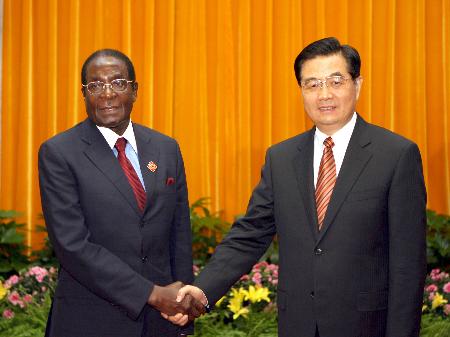
As China’s total energy consumption increases, a number of previously neglected issues including water pollution and excessive deforestation have begun to capture as much international attention as human rights and religious freedom. Diplomatically, China’s growing dependence on African oil has driven elites in Africa and the West to view China as a neo-colonizer, collaborator of oppressive regimes, and barrier to liberal reforms. Moreover, China has stimulated the West and neighboring states by modernizing its naval power—an ongoing attempt to safeguard its access to imported resources.


Chinese President Hu Jintao with Mugabe in 2006 (Image source: Sina News)

Ironically, Beijing has a positive impression of its growing energy demand. To many Chinese analysts, China’s development has benefited major energy exporters in Australia, Africa, and the Middle East by pushing up resource prices in the global market. Perceiving itself as a contributor to international development, Beijing has consequently failed to understand how various countries in the world could still view its development negatively, especially in the case of the U.S. and Europe.

China’s Opportunities

In the face of external doubts and criticisms, China is not in a position to suspend its development. In contrast, to reinforce its claim to economic growth, Beijing has gradually learned to emphasize sustainability in its development agenda—a measure to save itself from a disaster domestically and to justify its growth internationally.

On the one hand, China’s understanding of sustainability has found expression in its joint development plans in Africa. Today, Chinese investors are putting more resources into local education and health services, both of which are necessary for creating a sustainable development model in the host countries.

On the other hand, China has taken the lead to accelerate the development of green energy. As the world opinion on climate change becomes increasingly unified, China is unwilling to be the largest energy consumer. A greener economy will certainly provide Beijing with more confidence and legitimacy in the international community. 
China's Hybrid Cars (Picture Source: Infzm.com)

Guo Ding is contributing writer with China's Southern Weekly. His article was originally published on August 10th, 2010.  Yan Liu is Program Coordinator at Bridging Nations College of Energy and Environment, where he is responsible for the Mentorship Program.

California’s Clean Energy Battle

by Devin James Benavidez

This November, California voters will head to the polls to decide on two high profile elections. With close races in both the Senate and gubernatorial elections, the lion’s share of California voters’ attention in these mid-term elections may not be focused entirely in the right place. While the big name candidates and their ubiquitous campaign ads continue to bombard California airwaves, the vote on Proposition 23 might just be the most important decision on the ballot.

AB 32 was passed to help California establish a greener economy
This ballot initiative, also known as the “California Jobs Initiative,” seeks to postpone the implementation of the “Global Warming Solutions Act of 2006” until significant economic recovery has been made. The “Global Warming Solutions Act of 2006,” more commonly referred to as AB 32, mandates that by the year 2020 greenhouse gas emissions in California must be lowered to the levels experienced in 1990. 


Proponents of this proposition argue that the current economic recession makes it difficult for businesses to comply with the regulations stipulated in the landmark global warming legislation. Instead, they are calling for the suspension of the law’s implementation until the state’s unemployment level dips below 5.5 percent. The primary donors to the “Yes on 23” campaign, the Texas-based Valero Energy Corp. and Tesoro Corp, have contributed millions of dollars to stall AB 32 out of fear that this legislation could reverberate throughout the nation.  
California Smog (Image Source: AutoGreenMag.com)


Opponents of this proposition argue that not only does it stand to undermine the state’s progress toward mitigating the effects of global warming, but it also presents a danger to the emerging renewable energy technology sector. AB 32 has already created a favorable regulatory climate for investors in renewable energy technologies, and has in turn attracted millions of dollars in investments, which created the foundation for the growth of green jobs.


According to a recent poll done by the Public Policy Institute of California, 67 percent of Californians supported AB 32, indicative of the population’s desire to move forward with green job creation and greenhouse gas reductions. The global warming law in California has been seen as a benchmark, providing a framework that could have a symbolic effect and be replicated in other parts of the country. As we move closer to the mid-term elections in November, Proposition 23 in California acts as what some call ‘ground zero’ in the fight to expedite the transition into a future of clean energy.    


Devin Benavidez is a Research Intern at Bridging Nations, and has a BA in Political Science from California State University, Long Beach.

Inception of the College of Energy and Environment


A Timely Response to Prepare for Tomorrow's Energy Challenge

“To truly transform our economy, protect our security and save our planet from the ravages of climate change,” stated President Obama in February 2009, “we need to ultimately make clean, renewable energy the profitable kind of energy.”

The speech was delivered to audience all over the world, yet Dr. Prakash Ambegaonkar, Founder and CEO of Bridging Nations Foundation in D.C., might be the most excited to hear America’s new economic orientation.

Dr. Prakash, better known as Dr. P, established Bridging Nations in 2002. The organization focuses on the relations between China, India and the U.S. All of the three states are significant players in the global energy future: China and India have been leading energy consumption growth, while America remains the world’s largest polluter.

Dr. Prakash Ambegaonkar
Just at the time when President Obama announced his commitment to clean energy, Dr. P came up with an ambitious idea: a graduate program in Energy Technology and Policy. “The emergence of energy-centric economy has changed the paradigm of international relations,” Dr. P stated. “Through an education program that focuses on clean technology and green jobs, Bridging Nations will be able to inspire technology and policy innovations.”


An Inter-disciplinary Program

In the summer of 2009, Bridging Nations started contacting potential professors. The progress was remarkable. Within four months, the organization recruited an impressive faculty team, which is composed of energy experts all over the world. These include Dr. Eric Martinot, Senior Research Director at Institute for Sustainable Energy Policies in Tokyo, Professor Vijay Nilekani, Executive Technical Director at the Nuclear Energy Institute in D.C., and Dr. Wolfgang Kroger, Professor at the Swiss Federal Institute of Technology in Zurich. In 2010, Dr. P’s education initiative became licensed under the name of Bridging Nations College of Energy and Environment.


View our slideshow (click "menu" to view in full screen)

Born and raised in India, Dr. P received his PhD in the U.S. This combination of different backgrounds has had a considerable influence upon the College he is trying to start. “In India, about 200 million people enroll in high school every year; among them, only 14 million move on to college; and eventually, only 5 million people graduate.” This concern about access to education has driven Dr. P to ensure that the College of Energy and Environment will be an affordable learning experience. “Education is a birthright, and we will make it as accessible as the air we breathe.”

It's Time for Student Recruitment

Trained to be an engineer, Dr. P is also a strong believer in technology innovations. Hence the graduate program will not only offer courses on policy-making, but will also include courses on engineering. This multidisciplinary approach has impressed the College’s faculty members, especially Dr. Martinot, who emphasized to Dr. P that there are few institutions as comprehensive as the College of Energy and Environment. Dr. P himself is also full of confidence, as Bridging Nations is moving in full speed toward recruiting students.

Bridging Nations CEO Interview on India-US Strategic Dialogue


Bridging Nations CEO Dr. Prakash Ambegaonkar was interviewed by the US Department of State last week regarding the India-US Strategic Dialogue. Click play above to watch portions of this interview.

Indian Power Corporation Joins Hands With Israeli Company


India PR Wire: Sahara India Power Corporation Limited (SIPCL), a subsidiary of Sahara India Group, and Safesky software of Israel, have signed a Memorandum of Understanding (MOU) for promoting and manufacturing advanced solar power and other technologies for Indian users. In particular, the results would be seen in rural areas where the power deficit is very high. This advancement is far ahead of the present technology and will provide a solar power plant in a Sahara location in India.

India Energy Transformation


It is reported by WorldChanging that India is working on a large scale solar energy project that will revolutionize the power industry in the country, as well as provide an example for the world to follow. If the proposed changes come to life India would become the world leader in solar energy, followed by Germany, Spain, Japan, and the United States. An incredible amount of jobs would be created, domestic market size would grow, along with export manufacturing. The initiative includes the development and implementation of energy efficient products, buildings, and power generation. Also, a newly revised policy to upgrade India’s power grid, and a growing portfolio of Clean Development Mechanism Projects are included (click to see a new list of recently submitted CDM projects).

To get the initiative off the ground, India needs to be an upfront investment and a strong political will to carry the project out, with the proposed end date in year 2050. While costs would be extremely high to create the technology and necessary innovations, there would be a cost return on the investment and India would see much profit in the long run.


Expansion of India’s power-generation infrastructure puts it in a prime position to recreate how it produces and distributes energy. Unmet demands, estimated to as much as 80 percent of current installed capacity, along with concerns for shrinking supplies and increasing energy prices help speed the process. Government programs are already in place to encourage domestic solar manufacturing; these include small-scale solar lighting systems as well as commercial-scale solar plants.

A few things stand in the way of implementation and overall project’s success . First is the initial cos; India simply does not have the means or the machinery to start a project at such a national level. The state and national governments do not have strong communication, at this point, on the issue. Many government bans and tariffs make the creation of necessary products difficult. For example, generating capacity, ability to get power onto the grid, and to charge a fair price pushes facilities to remain with carbon-intensive facilities. Tax and tariff policies discourage the manufacturing of new products and as a result cutting edge technologies are not as sought after. Also, current electrical policies negatively influence (especially in rural areas) labor market goals.

Is a large-scale energy transformation possible for India? Will fossil fuels remain India's primary energy source or will smarter technologies prove more powerful?

Green Jobs Become Major Issue in UK Elections


According to article from the British newspaper The Guardian, Gordon Brown and Nick Clegg, two of the top candidates in Britain's upcoming election, both launched green manifestos outlining their energy and environmental policies. The manifesto of Gordon Brown's Labour party said that the Liberal Democrats' ban on new nuclear power would endanger energy security and climate change goals. The Liberal Democrats' manifesto pledged to redirect £3.1bn from other spending programs to stimulate the creation of 100,000 jobs in renewable energy. Other possibilities include building on the nuclear industry already in the north-west and concentrating the development of new carbon capture and storage technology for coal power in Yorkshire and Humberside.

Baby Boomers Natural Fit For Green Jobs

A recent report from the Council of Adult and Experimental Learning reports that green jobs are a 'natural' fit for the baby boomer generation. The baby boomer's contribution to the green economy is increasing, as 31% of Americans who say that 'working to preserve the environment' is extremely appealing.

Is that true for you?

Read the article here!

The Guardian: "US military warns oil output may dip causing massive shortages by 2015"

Photograph: Katja Buchholz/Getty Images
A recent article in the British newspaper The Guardian reports that the US military is warning of drastically rising gas prices and political and economic instability due to oil shortages in the near future. This report will likely have a great impact on the debate over "peak oil", or the tipping point when there is more demand for oil than supply. The need for serious investment in energy development and education is all the more clear in light of this new evidence.

Senate Leader Reaffirms Support for Climate Bill


The Senate's top democrat, Harry Reid, said he is committed to spending more time on the floor this year discussing comprehensive climate and energy legislation. He wants to bring a bill from Senator Kerry (D-MA), Lindsey Graham (R- SC), and Joe Lieberman (I-CT) to the floor later this spring or summer.

Click HERE for the article!

2010 Collegiate Alt-Energy Challenge!

Did you know one-fourth of the world's population lives without electricity? Investors Digest is holding its 2010 Collegiate Alt-Energy Challenge! Submit your 2-minute video for innovative, low-cost, alternative energy-related solutions, products or technologies. Cash prizes!


Click here for more info!

The Economist: Progress in Biofuels Stalled

According to a recent article in the Economist, America's efforts to promote and develop biofuels such as ethanol have not yet achieved the "ambitious" goals set by the EPA.

A major problem is that the cost of producing these fuels is often too high to make them commercially viable. There are some signs of progress by companies both in reducing the cost of breaking down cellulose, and in the production of "advanced biodiesel." The latter refers to using algae technology to create fuel, an exciting but expensive path towards more effective biofuels.

With more research like this, backed by expanded education in biofuels and related subjects, this impasse can hopefully be overcome. Biofuels hold a lot of promise in reducing carbon emissions from cars and other modes of transportation, and they will likely form an important part of our future energy picture.